



2026 General Tools Award Winner – Greg Galer
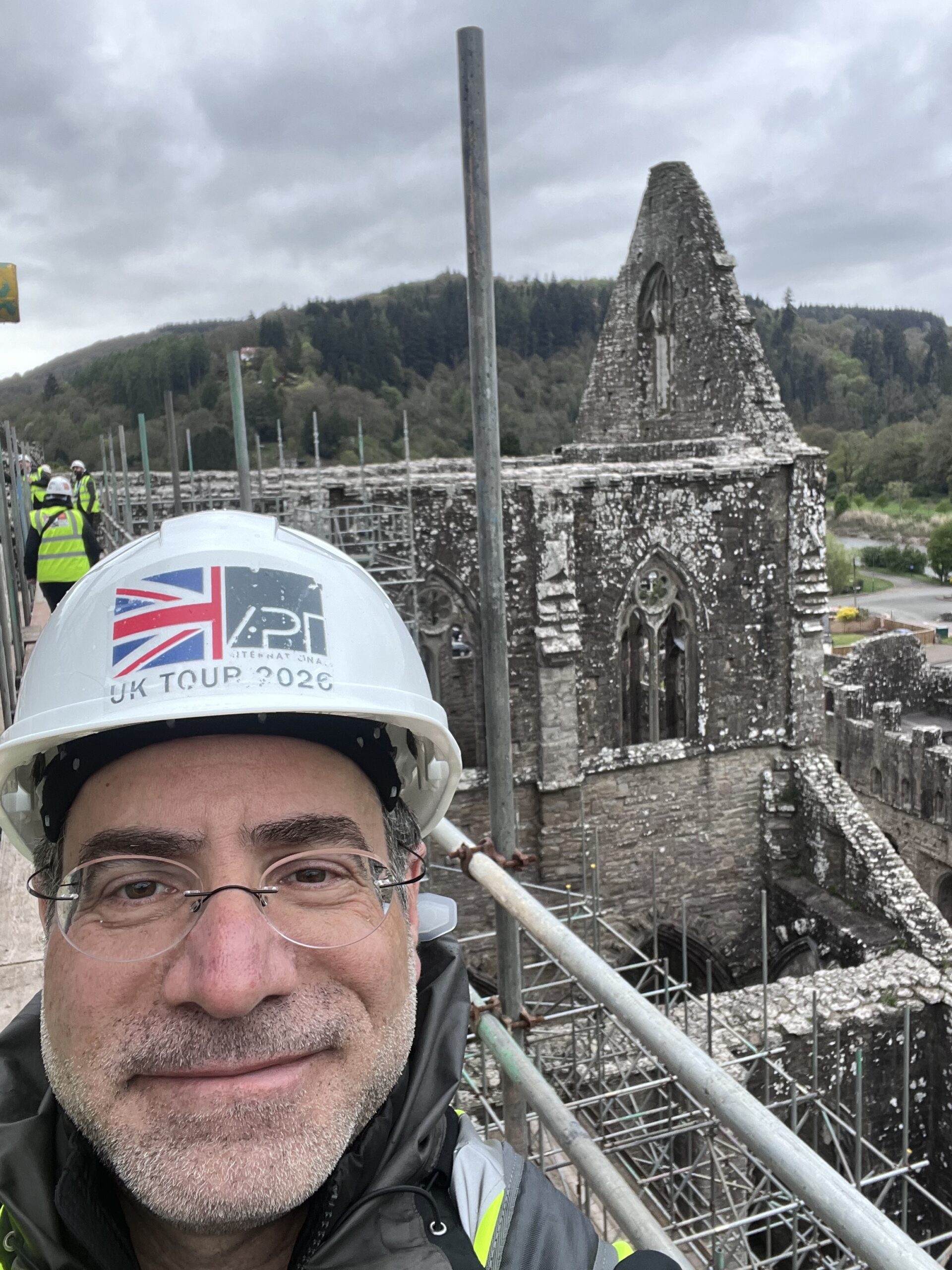
Greg Galer atop scaffolding at Tintern Abbey in Wales, a highlight of the APT 2026 UK Study Tour.
2026 General Tools Award Full Citation
As presented by Christopher Marston at the Society for Industrial Archeology 2026 Annual Business Meeting in Norfolk, Virginia
Greg Galer served the SIA as a member of the Vogel Prize Committee from 2004 to 2009, serving as chair his last year. Although he was long on the short list to run for our board of directors, he always had to beg off due to other commitments, strongly feeling he would only commit if he could devote the time it demanded. When you hear of his accomplishments, you’ll understand why. And you will appreciate that he has indeed given noteworthy, beyond-the-call-of-duty service, over an extended period, to the cause of industrial archeology.
Greg was introduced to IA early as an undergraduate student and research assistant for Pat Malone at Brown University where he earned his BA in American Civilization. Like so many of us, Greg’s first SIA exposure was because a friend or mentor invited him to a Society event. In Greg’s case, Pat Malone took him along on a tour of power plants with the Southern New England Chapter around 1986. Pat contributed greatly to this citation and Greg credits Pat, the 1996 General Tools Awardee, as being his most influential mentor. Over the years, they have often collaborated on projects and programs.
Greg’s honors thesis, “The Boston Bridge Works and the Evolution of Truss Building Technologies” was a sign of the trajectory he was on. He went on to obtain his Ph.D. in the History and Social Study of Science and Technology at MIT. His dissertation, “Forging Ahead,” told the story of the Ames family of Easton, Mass., and their iron works that spanned two centuries, illustrating the particulars of a metal-working enterprise that was part and parcel of the American Industrial Revolution. With Robert Gordon (2010 General Tools Awardee), he wrote a book that focused on the family’s iron works in Connecticut: Connecticut’s Ames Iron Works: Family, Community, Nature, and Innovation in an Enterprise of the Early American Republic (1998).
As an undergraduate, Greg also volunteered at the Slater Mill in Pawtucket, Rhode Island. Greg’s field investigations of industrial landscapes contributed significantly to the prize-winning book, The Texture of Industry, authored by Pat Malone and Robert Gordon in 1994. Greg’s inventory work and database development were crucial in the establishment of the Blackstone River Valley National Heritage Corridor that has since become a national park. His personal research saved two wonderful examples of Boston Bridge Works’ pony trusses in Albion, Rhode Island. Both are now rehabilitated and are key features of the Blackstone River Valley National Historical Park.
From 1989-92, Greg worked at the Valentine Museum in Richmond, Virginia, advancing from the Coordinator of Industrial History to the Project Director for the Valentine Riverside project at the Tredegar Iron Works site. He managed the pre-construction phases of the redevelopment of the historic Tredegar site, planning which set the stage to turn this once restricted-access industrial site into a publicly interpreted one. He worked closely with the Raber Associates team which in 1992 researched and documented Tredegar’s industrial history and waterpower system. He established many of the Tredegar site’s interpretive schemes and concepts ultimately developed by the Valentine after his departure. Long known as the “Ironmaker to the Confederacy,” Tredegar was also significant for its first workforce of Welsh artisans—thus the name Tredegar—and its later use of enslaved workers in some of the most skilled aspects of the production process in the puddling and rolling mills.
Greg Galer and fellow curator Gregg Kimball were able to see the process firsthand at Cleveland Track Material in Cleveland, Ohio, where they traveled to study the process. Skilled black workers who had worked the mill in Richmond and later in Chesterfield County had moved to Cleveland when a new owner purchased the works. “The Gregs” documented, through video and oral histories, one of the two remaining hand-fed rolling mills in the United States—the same mill that had rolled the iron plates for the CSS Virginia. In Cleveland, Greg learned the value of shop floor experience by learning to use tongs with hot, rapidly moving bars of iron in the rolling process. Greg Galer later told Pat Malone:
“Understanding of what the workers do and what the job is like is incomplete without personal experience… I feel that my understanding of the operation of a rolling mill was changed by an order of magnitude after I tried it myself. Most of the increased knowledge was experiential and difficult to communicate, and that is exactly the point. I learned things I didn’t know previously because they are things that you can only get if you try them… We as industrial historians should take the opportunity to obtain such experiences whenever possible. Certainly no one should argue that by trying something like this you completely understand what the worker experiences… Nonetheless, the impressions you gain are hard if not impossible to get anywhere else.”
This experience prepared Greg to assist curator Gregg Kimball in the development of The Working People of Richmond, a major NEH-funded exhibition mounted in Richmond’s Tobacco Row in 1992. Greg played a central role in the exhibition of industrial artifacts including a Bull Durham tobacco bagging machine, a nineteenth-century tobacco press, and a section of the Tredegar roughing rolls – later used in the interpretation at the Tredegar site. Through this work, they made a tremendous impact on our understanding of Richmond’s technological and labor history.
As Curator of the Stonehill Industrial History Center at Stonehill College, in Easton, Mass. from 1998 to 2009, Greg built the Stonehill Industrial History Collections from a hidden, poorly indexed archive stored in very poor, high humidity conditions, to a collection in climate-controlled storage with a conservation lab, reading room and public exhibit area. It is utilized by not just students and faculty but by the regional community and scholars throughout the U.S. More than just a “shovel museum,” the Stonehill Collection has grown with new acquisitions and has valuable material on industrial topics including shovel making, ironworking, railroads, and land development throughout the country. More SIAers should know about this amazing collection, which Greg notes is ripe for many more dissertations! While in Easton, Greg served as Vice President and Program Chair of the SIA Southern New England chapter from 1999 – 2001 and led the Southeastern Massachusetts tour (including the Stonehill Collection and Tremont Nail factory) at the SIA Providence conference in 2004.
Greg then served as Vice President of Collections and Exhibitions at the New Bedford Whaling Museum in New Bedford, Mass. from 2010-12 displaying his ability as a talented facilitator of development projects and over 20 exhibits. He managed a collection of over 1 million items and restoration of historic interior spaces for exhibition, preserving their unique, historic character while enhancing the visitor experience.
As Executive Director of the Boston Preservation Alliance for over nine years beginning in 2012, Greg was an eloquent and well-informed voice for the protection of architectural heritage and the encouragement of appropriate design in new construction. He understands the importance of place and the role of buildings and engineering structures in defining the character of a city and he promoted adaptive re-use projects with great success. Among his memorable preservation efforts was trying to save the Northern Avenue Bridge. He served on the jury exploring reuse and worked with both the City Engineer and preservation engineer Robert Silman and built a coalition to imagine alternatives in response to the Army Corps of Engineers’ plan to tear it down.
At the National Historic Landmark Charlestown Navy Yard, Greg worked to save the Chain Forge building and its historic machinery. The site had been transferred from the Navy to the Boston Redevelopment Authority and included within the boundaries of the Boston National Historical Park in 1980. In 2013, the park sponsored a HAER Level 1 documentation project and Greg managed a special resource study of the Chain Forge equipment by Raber Associates as part of planning for proposed redevelopment of the building as a hotel. While over three dozen significant pieces were recommended for exhibition and interpretation, the development plans unfortunately stalled during the COVID pandemic, with the stipulation that re-use must now retain the historical character of the building and some of the in-situ equipment. It was during his tenure at BPA that the Boston Society of Architects nominated Greg for Honorary AIA Membership, which he received in 2022.
Since January 2022, Greg has been the Executive Director of The Association for Preservation Technology International. Taryn Williams, who co-chaired the search committee, said APT “won the lottery when they hired Greg,” and that his background in industrial heritage and appreciation of preservation are fundamental to why he’s been so effective in his role there.
Reflecting on his invitation to a 2024 MIT Symposium on the status of the History of Technology as a field of study, Greg said he was honored but wondered what he could offer to a room full of mostly university faculty and highly regarded published scholars when he’d been away from academia for so long. But then, he quickly realized that technology is and has been central to his work. “’Technology’ is right on my business cards!” he said, “It’s central to the organization I lead… It’s right in our Mission Statement!” I think we might say that the history of technology is Greg Galer’s heart and soul, that he’s right where he should be, and worthy of the 2026 General Tools Award.
Committee Chair Christopher Marston read the citation, on behalf of the other committee members, Mike Raber and Mary Habstritt. Unfortunately, Greg Galer could not be there in person to accept the award but sent a note of gratitude for Christopher to read.
Greg Galer Acceptance of General Tools Award – May 2026
Read by Christopher Marston at the Annual Business Meeting
Thank you, Christopher, to the selection committee, and to the SIA for this humbling recognition. I’m shocked to be placed alongside past winners – many mentors early in my career including the first recipient, Emory Kemp, and of course Pat Malone, without whom none of my career would’ve occurred. Pat helped me see a path to combine my loves of history and science that has provided incredibly rewarding and unique experiences: from the rolling mill; to working with architects, engineers, scientists, and craftsmen; to throwing out the first pitch at Fenway Park!
I recently led a group of APT members learning from stone masons over 200’ up atop scaffolding at Tintern Abbey in Wales, and from stone carvers and stained-glass conservators at York Minster. Just a few weeks ago, I returned to Sloss Furnace in Birmingham to pour iron – having last visited at the SIA Fall Tour in 1999!
Hands-on experiences and engaging with materials, skilled workers, and science are essential to our understanding of technology and the people and places who influence technological change. I remain committed to encouraging and providing opportunities for this powerful type of learning.
The worlds of the SIA and the Association for Preservation Technology, which I now lead, have significant overlap. (Our annual conference, this fall in Indianapolis, includes quarry tours! And I know you’ll get happily lost in APT’s Building Technology Heritage Library.) The foundational skills, friendships, and partnerships I made through the SIA have been vital to my many successes, including at APT.
I’m frustrated not to be there with you today. Just know that I continue to proselytize for the value of industrial archeology and the need to understand the technology of the past in order to preserve our historic resources for the future.
And … finally … to answer your burning question … Yes, that first pitch at Fenway was a strike!
Thank you,
Greg Galer