



2025 General Tools Award Winner – Mary Habstritt
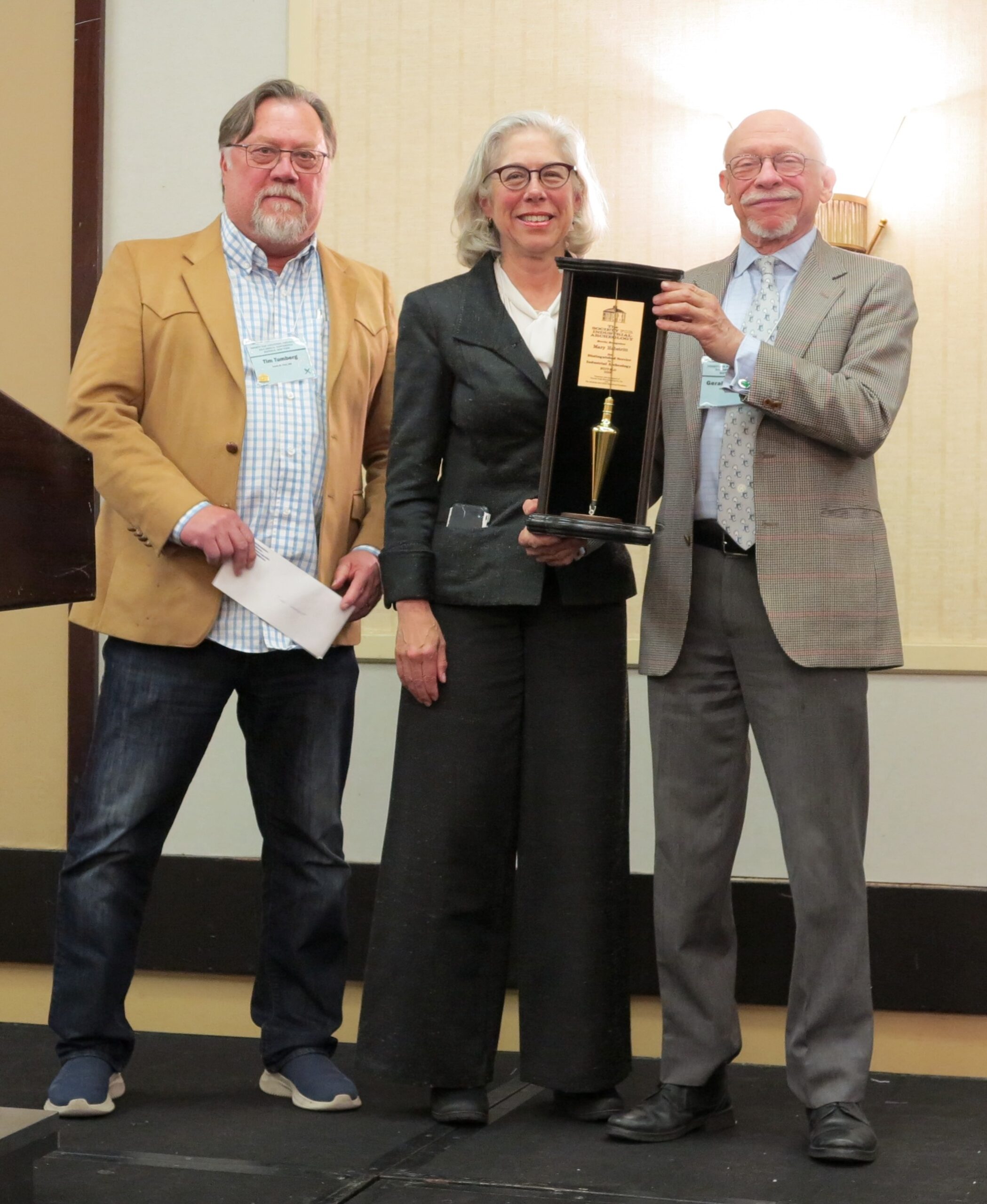
Mary Habstritt receives the 2025 General Tools Award at the SIA Annual Business Meeting during the 53rd Annual Conference in Buffalo, New York.
2025 General Tools Award Citation
Mary Habstritt was born in St. Cloud, Minnesota (the “busy gritty granite city”). Her great-grandfather worked as a granite cutter and her father was a laborer in the Great Northern car shops. She grew up in Minnesota and graduated from the College of St. Catherine with degrees in library science and humanities. After a stint in property management, she joined the James J. Hill Library in the acquisitions department. The library was noted for its mission to always be abreast of changing business and industry, so she was also in charge of de-accessioning no-longer-needed tomes. Working there she met SIA member Bob Frame III and was intrigued by his hundreds of miles of bridge surveys. He introduced her to the wonders of Industrial Archeology.
Deciding to get a master’s in library science, she enrolled at Columbia University, which then had the oldest library program in the country, founded by Melvil Dewey of the Dewey Decimal System. She was one of the last graduates before the Library Science program was terminated. She then had a reign as the “fines goddess” at the University of Minnesota Libraries.
While in New York, Bob invited her to the SIA Quebec City conference in 1989 and there introduced her to his friends in the Roebling Chapter, where Mary met Gerry Weinstein, SIA, her future husband, who further broadened her passion for IA. How many SIAers can say that they spent part of their honeymoon at the bottom of a Yooper copper mine?
She was in a ladies’ room at the Savannah conference in 1999 when she overheard the dire conversation that the upcoming Duluth conference was going to be cancelled due to the co-sponsor backing out. Perhaps her latent desire to run things emerged at that moment because she volunteered to make it happen. She organized it largely from New York, though it didn’t hurt that she had cousins in Duluth to stay with. It was the first conference with registration run through SIA headquarters rather than through the local committee, and also the first one where e-mail was used to communicate tour details to registrants. It was also among the last conferences to produce a conference poster.
With things seemingly going well, as the Duluth conference drew to a close, Mary enjoyed the banquet, perhaps a bit too much, dancing with Ed Rutsch and overindulging in slivovitz. Returning to her hotel room, which served as the hospitality suite, she was informed that the hotel staff had already been by to quell the raucous SIAers and was offered some 12-year-old Scotch to mollify her. Thinking she was off duty the next morning, since a tour guide was supplied by the mysterious Iron Range Resources and Rehabilitation Board, she planned to spend the next day’s tour to the Soudan mine recovering in the back of the bus. Things started to go awry at the state park when the tour guide announced his departure and disappeared into his wife’s waiting car and the park ranger stepped aboard and asked, “Who’s in charge of this tour?” With a cool, if aching, head Mary took over and discovered that the lunch pasties had arrived frozen stiff. She commandeered the staff microwave and a volunteer board member, and they started thawing pasties as fast as they could while the ranger kept the tour-goers busy.
Getting elected to the SIA board of directors in 2000 was a result of the success of that conference. She soon volunteered the Roebling Chapter to run the 2002 conference based in Brooklyn, NY. With the city practically on its knees after the destruction of the Twin Towers, it might have been a no-brainer to cancel the conference, but the Roebling volunteers persisted, with Mary strong-arming or charming reluctant factory owners to let the SIA in. A top-to-bottom tour of Pfizer, where penicillin was first mass produced, and of Domino Sugar, once the world’s largest refinery, were highlights. Running the Brooklyn conference led Mary to become chair of the SIA’s Tours & Conferences committee.
In 2003, with her term on the SIA board expiring, Mary became SIA’s first paid Events Coordinator. Mary tailored support to the needs of the local committees who planned some great conferences and fall tours in places as diverse as Montreal, Northeast Montana, Providence, Wilmington, Milwaukee and Detroit. When Cydney Millstein proposed a conference in St. Louis, Mary pulled it off with very few boots on the ground, even after the co-sponsor responsible for producing the guidebook backed out. She used the SIA board’s network to find the right contact at US Steel to get us into the Granite City Works just over the border in Illinois. As the blast furnace was tapped, and rivers of molten iron passed closely by the SIAers on the casting floor, perhaps some were thinking it was a once-in-a-lifetime experience. Those on the mining tour who came back coughing from the lead smelter will certainly never forget it. Mary really had the knack of convincing reluctant factory owners to let us get up close and endangered. Even after she left the job as Events Coordinator, she got called back in to assist with the Youngstown and Rosendale fall tours
In 2008 she successfully ran for SIA President, being the first, except the first – Robert Vogel – to skip serving as Vice President first. While in that role, she did her best to avoid re-inventing the wheel through improved accountability and record keeping. Seeing that the conferences and tours were in good hands she stepped back a little to concentrate on helping the society run smoothly. For the first time she invited committee chairs to report directly to membership at the annual meetings.
Mary’s work arranging tours and writing about industrial sites for guidebooks and promotional materials inspired her to advocate for these disappearing places. She refused to simply accept that the SIA “kiss of death” was the end. She became president of the Roebling Chapter after the Brooklyn conference, used that position to advocate for the preservation of New York’s historic industrial sites, and encouraged the national organization to take a more proactive role. She created a new position of Preservation Chair for the Roebling Chapter, ran postcard campaigns, wrote letters and testified at public hearings, eventually working as a freelance preservation advocate.
She tirelessly fought the good fight against IKEA to save the last privately-owned graving dock in New York Harbor, and against Columbia University for 25 acres of historic industrial sites, many related to milk pasteurization and automobile manufacturing, slated to be buried under the university’s Manhattanville campus. She successfully stood in the way of developers’ plans to seriously alter Cass Gilbert’s Austin Nichols & Co. warehouse, the famous architect’s first work in concrete. The vast alterations of the historic Domino Sugar factory left her feeling that the deck was stacked against historic preservation in the city, although her advocacy did save the pier-side gantry cranes.
In 2009, instead of giving up on preservation she took on an even more impossible job – saving 750 tons of steel, brass, copper and wood floating in the Hudson River, as president and museum director of the Lilac Preservation Project, working to restore America’s oldest lighthouse tender, the US Coast Guard Cutter Lilac. As if keeping a historic ship afloat and creating educational and cultural programs to interpret the ship and engage the public wasn’t hard enough, she has had to continuously engage in contentious contract negotiations with Lilac’s landlord, the Hudson River Park Trust. Despite a mandate to provide a place for historic ships in the park, the management was really only interested in ships that paid their way, namely floating bars and cruise boats. The experience gained in dealing with the Trust has made her the go-to person when New York’s historic ships are threatened by waterfront gold reflecting in the eyes of developers. She founded The Historic Ships Coalition to help these ships speak with one voice before community boards and city commissions and agencies. She is also a member of the Waterfront Wenches, whose mission cannot be revealed. Occasionally, when saving an old ship also seems like an uphill (upriver?) battle, Mary tells the Board she needs an exit plan. If that means retiring to her house in St. Paul, real estate developers there and the local politicians in their pockets had better watch out.
Mary remains quite aware that volunteer organizations can have low points, often caused by burnout of long-serving boards. Sensing that the Roebling Chapter was at such a crossroad, she yet again stepped into the presidency this year, and I expect we all wish her and the chapter well.