



SIA Norfolk 2026 – Tours & Events
Conference Home • TOURS & EVENTS • Registration Information
Presentation Sessions • Hotel & Travel • “Birds of a Feather” Sessions
CONFERENCE EVENTS – Included in Registration
PLEASE NOTE: Tour itineraries are subject to change. Schedules and times provided in this brochure are approximate. Please check emails, the conference website, and your registration packet for updated times, details, and web links. If you have additional questions, contact SIA event coordinator Courtney Murtaugh: siaevents@siahq.org
THURSDAY, MAY 28
6 PM – 9 PM Opening Reception at Hilton Norfolk The Main, third floor. The reception will include hors d’oeuvres, cash bar, and an orientation to the maritime history of Hampton Roads. Our featured speaker will be Dr. Paul Ewell, Chair, School of Business, North Carolina Wesleyan University; founder, Eastern Shore Maritime Museum in Onancock, VA; and co-organizer of the SIA Norfolk conference.
“From the Dugout Canoe to the Carolina Skiff: The Evolution of Chesapeake Bay Workboats”
This presentation chronicles the workboats of the Chesapeake Bay from the early days of the log canoe through the era of modern fiberglass boats used by working watermen. Vessels featured include the pungy, pilot schooner, bugeye, skipjack, scow, buyboat, deadrise, etc., and descriptions of the fisheries in which they worked.
We’re going to try something new in Norfolk – organizing informal gatherings of people by their interests that we’re calling “birds of a feather“ sessions. When you register at the conference, we will have some printed ribbons to attach to your badge for these interest groups: Iron and Steel, Bridges and Infrastructure, and Industrial Heritage Museums. We will also provide blank ribbons for your interest if it’s not one of the above. You can find your people by looking for others with the same ribbon. The “birds of a feather” sessions will be flocking together shortly after Paul Ewell’s talk Thursday night. Details will be provided at the conference, but you can contact Tony Meadow in advance at: tmeadow@ferrumwest.com.
FRIDAY, MAY 29
Choose one of the following all-day tours (lunch and transportation included)
F1 – NORFOLK SHIPYARDS (8:00 – 5:00)
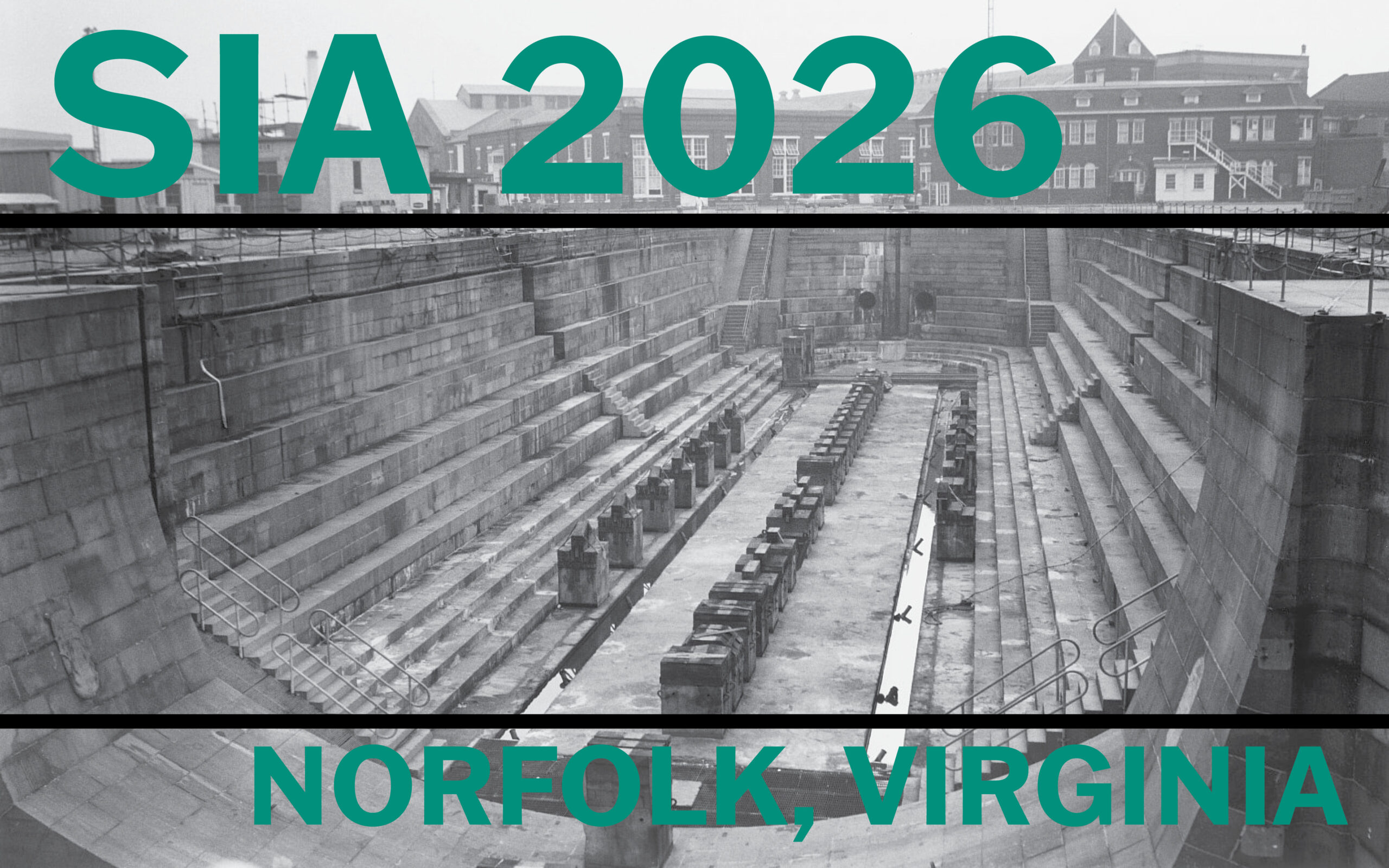
This tour will offer rare opportunities for behind-the-scenes tours of two historic shipyards. Colonna’s Shipyard is the oldest continuously family-owned and -operated shipyard in the US. Founded in 1875 by Charles J. Colonna, a 26-year-old ship carpenter who began with modest pier-side repairs and a horse-powered marine railway capable of lifting just forty tons, the yard has grown into a diversified operation spanning commercial and government ship repair, large-scale steel fabrication, and precision machining. The shipyard’s facilities today include multiple dry docks, marine railways, and a 1,000-metric-ton marine travel lift—once the largest in the world. Colonna’s offers a rare opportunity to observe an active shipyard showcasing the evolution of American ship repair technology from the wooden sailing vessels era to modern steel-hulled naval craft. Norfolk Naval Shipyard is the oldest and largest industrial facility belonging to the US Navy, established as the Gosport Shipyard in 1767. A birthplace of naval technology, NNS has built historic sailing ships, pioneer ironclads, battleships and aircraft carriers throughout its history. Constructed of massive blocks of Massachusetts granite in 1827-34, Dry Dock No. 1 is the oldest continuously operational dry dock in the US and a National Historic Civil Engineering Landmark. The shipyard also preserves antebellum warehouses, World War I and World War II–era production facilities, eight dry docks, and a hammerhead crane, constituting one of the most historically layered naval-industrial landscapes in the Western Hemisphere.
Note that all F1 tourgoers will be required to submit the following to access the NNS facility: First—Middle—Last Name / Date of Birth / Social Security Number / Real ID Number (U.S. citizens only)
F2 – NEWPORT NEWS SEAFOOD (8:00 – 5:00)
This tour will cross the James River to visit three sites on the Virginia Peninsula. Newport News Seafood Industrial Park is a working waterfront complex on the James River, home to seafood processors, crabbers, boat building and repair yards, machine shops, and marine towing and construction companies. The park represents one of the most intact and active concentrations of small-scale maritime industry remaining in Hampton Roads and offers a living laboratory of vernacular waterfront industrial architecture, marine railway technology, vessel construction and repair practices. Sam Rust Seafood is a family-owned wholesale seafood processor and distributor of fresh Chesapeake Bay and Atlantic seafood since 1938. Sam Rust employs sustainable harvesting practices and a state-of-the-art ozone water sanitation system that represents the modern evolution of food-safety technology in the seafood industry. Fort Monroe National Monument is a 565-acre fort strategically located at Old Point Comfort overlooking Hampton Roads harbor. Designed by French military engineer Simon Bernard and completed in 1834, the six-sided, moat-encircled bastion fort is the largest stone fortification in the US. The fort features original masonry casemates, twelve concrete Endicott-era gun batteries, the Lincoln Gun (a 49,000-pound Rodman cannon), and an archaeological landscape spanning four centuries from the Kecoughtan Indians to the fort’s 2011 decommissioning.
F3 – FORTIFICATION AND MARITIME HISTORY – $25 Surcharge Applies (8:00 – 5:00)
This tour will explore two major sites of fortification and maritime history on the Virginia Peninsula. The tour will begin at Fort Monroe National Monument (see the description in Tour F2 above). Founded in 1930, the Mariners’ Museum and Park offers an international collection of ship models, figureheads, paintings, navigational instruments, and maritime artifacts spanning centuries of seafaring history. The USS Monitor Center preserves the ironclad’s revolutionary 115-ton revolving gun turret (recovered from the Atlantic Ocean floor in 2002), two Dahlgren shell guns, the unique John Ericsson-built vibrating lever steam engine, gun carriages, hull plates, and personal effects of the crew. Visitors can observe the ongoing conservation process of the turret which is periodically submerged in a 90,000-gallon alkaline solution to remove corrosion-inducing ocean salts. The museum also features a full-scale reconstruction of the USS Monitor, allowing visitors to grasp the scale and ingenuity of John Ericsson’s design, which fundamentally transformed naval architecture and warfare.
F4 – Colonial Williamsburg – $30 Surcharge Applies (8:00 – 5:30)
Colonial Williamsburg is the world’s largest living history museum, occupying 300 acres in the restored eighteenth-century colonial capital of Virginia. The site preserves and interprets the material culture of colonial-era trades through more than twenty active craft shops where skilled artisans demonstrate historic trades including blacksmithing, brickmaking, gunsmithing, printing, silversmithing, coopering, wheelwrighting, and foundry casting, using period tools, materials, and techniques documented through extensive historical and archaeological research. The tour will visit CW’s brand-new Campbell Archaeology Center showcasing unique artifacts from several trade shops, and offer behind-the-scenes access to active archaeological excavation and preservation projects on the grounds, including the African Baptist Meetinghouse. We’ll see how material evidence is recovered, interpreted, and used to reconstruct the industrial and craft economies of colonial Virginia from CW staff members. Colonial Williamsburg provides SIA members an unparalleled opportunity to observe pre-industrial manufacturing processes in operation, to examine the tools, shop layouts, and production methods that preceded the Industrial Revolution, and to engage with the archaeological fieldwork that continually refines our understanding of early American industry.
FRIDAY EVENING
Dinner on your own.
SATURDAY, MAY 30
8:00 AM – 11:30 AM – MORNING PRESENTATION SESSIONS (Coffee and soft drinks will be available; session topics, presentation titles, and a list of speakers will be posted on the SIA website: www.sia-web.org
11:30 AM – 2:00 PM – ANNUAL BUSINESS MEETING AND LUNCHEON (INCLUDED IN THE COST OF REGISTRATION)
2:15 PM – 5:00 PM – AFTERNOON PRESENTATION SESSIONS
ALL DAY – EXHIBITS, POSTERS & BOOK SALES
OPTIONAL ACTIVITIES
(Extra fees apply)
THURSDAY, MAY 28
T1 – VIRGINIA BEACH AND EASTERN SHORE – $100 (7:30 – 5:00)
This exploration of the Chesapeake starts at the Chesapeake Bay Foundation, Brock Environmental Center in Virginia Beach. The 2014 LEED Platinum-certified building is one of the greenest in the world, which generates its own energy through solar panels and wind turbines, collects and filters rainwater and uses composting waterless toilets. CBF’s oyster barge demonstrates the intersection of traditional watermen culture with sustainable oyster restoration practices. We’ll then cross the 23-mile-long Chesapeake Bay Bridge-Tunnel to Virginia’s Eastern Shore. Opened in 1964 and recently expanded with parallel tunnels, the CBBT combines trestle bridges, man-made islands, and two-mile-long tunnels that pass beneath the bay’s shipping channels, replacing a ferry system that had connected the Eastern Shore to the mainland since the late nineteenth century. Barrier Islands Center is a cultural history museum housed in three historic almshouse buildings. The museum’s collection of over 7,500 artifacts portrays the once-thriving oystering/fishing communities, lifesaving stations, hunting lodges, and resort hotels that populated Virginia’s chain of barrier islands before devastating hurricanes forced abandonment. Today these twenty-three uninhabited barrier islands constitute the East Coast’s longest stretch of undeveloped coastline. Cape Charles is a scenic 1884 planned community founded as a terminus for the New York, Philadelphia & Norfolk Railroad, where car floats, steamers, and later automobile ferries crossed the Chesapeake Bay to Norfolk—a multimodal system that operated until 1964. The Cape Charles Museum is housed in a 1947 diesel-electric generator station and features a locomotive, caboose, freight cars, jetty house, pilot house, and artifacts from a bygone railroad-ferry transportation network that shaped the economic life of the Eastern Shore.
Lunch is included.
T2 – JOINT BASE LANGLEY-EUSTIS – $100 (8:00 – 5:00)
Joint Base Langley-Eustis is a combined U.S. military installation on the Virginia Peninsula, formed in 2010 by the merger of Langley Air Force Base in Hampton and Fort Eustis in Newport News. Langley Field, established in 1916, is one of the oldest continuously active air bases in the US and was a pioneering center for military aviation research, including early work by the National Advisory Committee for Aeronautics (NACA), the predecessor to NASA. Fort Eustis, established in 1918, has served as the Army’s primary transportation and logistics training center and is home to the U.S. Army Transportation Museum, which houses an extensive collection of military vehicles, watercraft, aircraft, and railroad equipment. The base’s potential tour sites—including air traffic control facilities, a K-9 unit, aircraft displays, the “Hush House” engine testing facility, and aerospace-related infrastructure—offer SIAers a rare inside look at the evolution of military-industrial technology, from World War I–era airfield construction to Cold War testing infrastructure and contemporary defense operations. This tour is subject to JBLE approval and requires advance security clearance for all participants. Lunch is included. Note that all T2 tour goers will be required to submit the following to access the JBLE facility: First—Middle—Last Name / Date of Birth / State / Real ID Number / Country of Citizenship
T3 – PORTSMOUTH WALKING TOUR – $50 (1:00 – 5:15)
Meet in the lobby of the Hilton for a short walk to catch the Elizabeth Ferry from Norfolk Waterside to the historic city of Portsmouth. The Naval Shipyard Museum documents the long maritime history of the Portsmouth area, with particular emphasis on the Norfolk Naval Shipyard (located in Portsmouth despite its name). Artifacts include ship models, uniforms, photographs, and navigational instruments tracing the shipyard’s role from the colonial era through the Civil War—when the Confederate Navy used Dry Dock No. 1 to convert the USS Merrimack into the ironclad CSS Virginia—to the modern era of nuclear ship repair. Lightship Portsmouth Museum occupies a 1915 vessel which served as a floating lighthouse along the East Coast, anchored at dangerous shoals and harbor entrances where fixed lighthouses could not be built. The vessel was retired from active service in 1964 and is now a National Historic Landmark. Olde Towne Portsmouth has one of the largest collections of historically significant residential and commercial architecture in the Chesapeake Bay region. Led by Karen Washburn of History Alive, the three-mile-long walking tour covers this nationally recognized historic district, which developed in direct relationship to the Norfolk Naval Shipyard and working waterfront. The streetscape preserves Federal, Georgian, Greek Revival, Italianate, and Victorian-era buildings that housed the merchants, shipwrights, naval officers, and laborers who sustained the shipyard economy.
Participants need to be physically capable of walking approximately 3 miles. No lunch included.
SATURDAY EVENING, MAY 30
SB – SATURDAY BANQUET – $100 (6:00 – 9:00 PM)
Saturday’s Banquet will occur in the Atrium of The Slover, 235 E. Plume Street
The Slover is a mixed-use civic building located in downtown Norfolk, Virginia, a short two-block walk from the conference hotel. Originally U.S. Post Office & Federal Courthouse completed in 1900 in the Neo-Palladian Revival style, it was used as the Norfolk City Hall from 1934-65. The newly renovated building houses a branch of the Norfolk Public Library system and community event spaces, including the Atrium where the Saturday Banquet will be held. Situated in Norfolk’s revitalized downtown core, The Slover occupies a prominent position in the city’s ongoing transformation of its historic waterfront commercial district, providing conference attendees with an evening venue that reflects Norfolk’s investment in adaptive reuse and civic architecture.
SUNDAY, MAY 31
S1 – NORFOLK HARBOR CRUISE – $75 (8:30 – 11:30)
The Port of Norfolk – Victory Rover Charter Cruise will traverse Hampton Roads, one of the world’s great natural deepwater harbors, located at the confluence of the James, Elizabeth, and Nansemond rivers at the mouth of the Chesapeake Bay. The cruise will showcase the working port facilities that have made Norfolk a center of maritime commerce and naval power for over three centuries. Landmarks include Lambert’s Point—historically one of the largest coal-loading terminals in the world, where the Norfolk & Western Railway (now Norfolk Southern) transported Appalachian coal for export—and the Norfolk International Terminal and Portsmouth Marine Terminal container ports, which are key components of the Port of Virginia, one of the deepest and busiest ports on the East Coast. From the water, passengers will observe the physical infrastructure of modern port operations—container cranes, coal piers, grain elevators, ship repair yards, and naval installations—set against the layered industrial and military landscape of Hampton Roads. The harbor cruise provides a comprehensive waterside perspective on the transportation, energy, and defense-related infrastructure that has defined this region’s economy from the colonial period through the present day.
Snacks and beverages will be available for purchase on board the Victory Rover.
MONDAY, JUNE 1
M1 – STIHL INC. – $25 (8:00 – 12:00)
Stay in Norfolk an extra day for a rare opportunity: a behind-the-scenes tour of STIHL Incorporated’s 150-acre campus in Virginia Beach. Opened in 1974 with fifty employees assembling a single model of chainsaw, Germany-based STIHL Group’s US headquarters has grown to over 2,300 employees producing more than 275 model variants of outdoor power equipment. The highly automated manufacturing plant employs 150 robots alongside its human workforce in a vertically integrated production process that includes injection molding, metal fabrication, engine assembly, and guide bar manufacturing. Virginia Beach was selected for its proximity to the Port of Virginia, enabling global distribution. Nearby stands the Cape Henry Lighthouse, a 54′ tall octagonal stone tower at the entrance to the Chesapeake Bay on the grounds of Joint Base Fort Story. Completed in 1792, it was the first federally funded lighthouse authorized by President George Washington’s new federal government, and Treasury Secretary Alexander Hamilton personally oversaw its construction. Built of Aquia Creek sandstone—the same Virginia quarry that supplied stone for the U.S. Capitol and the White House—the lighthouse guided mariners entering the Chesapeake Bay for nearly a century before being replaced by a cast-iron tower in 1881.
No bus or lunch provided. Tourgoers will be responsible for driving to the sites themselves. SIA will assist with arranging car sharing if needed.
Note that Real ID is required for all visitors to access the military installation.
ON YOUR OWN ACTIVITIES
Battleship Wisconsin Built at the Philadelphia Navy Yard and commissioned in 1944, Battleship Wisconsin served in WWII, Korea, and Desert Storm until 1991. Berthed a short walk from the Hilton at Nauticus, you may book your own guided tour here: https://nauticus.org/explore/battleship-exhibits/about-the-battleship/
Nauticus Maritime Discovery Center: https://nauticus.org/
Chrysler Museum of Art and Perry Glass Studio: https://chrysler.org/
Norfolk Tides vs. Durham Bulls Take The Tide Light Rail to Harbor Park and enjoy AAA minor league baseball right across the Elizabeth River from Colonna’s Shipyard and Norfolk Southern RR bascule bridges. https://www.milb.com/norfolk